


Almond Eye Surgery in Turkey: Procedure, Recovery, Prices
Almond Eye Surgery in Turkey is a specialised eyelid procedure designed to reshape and support the outer corner of the eyes, creating a more elongated, lifted or almond-shaped appearance while preserving natural eyelid function.
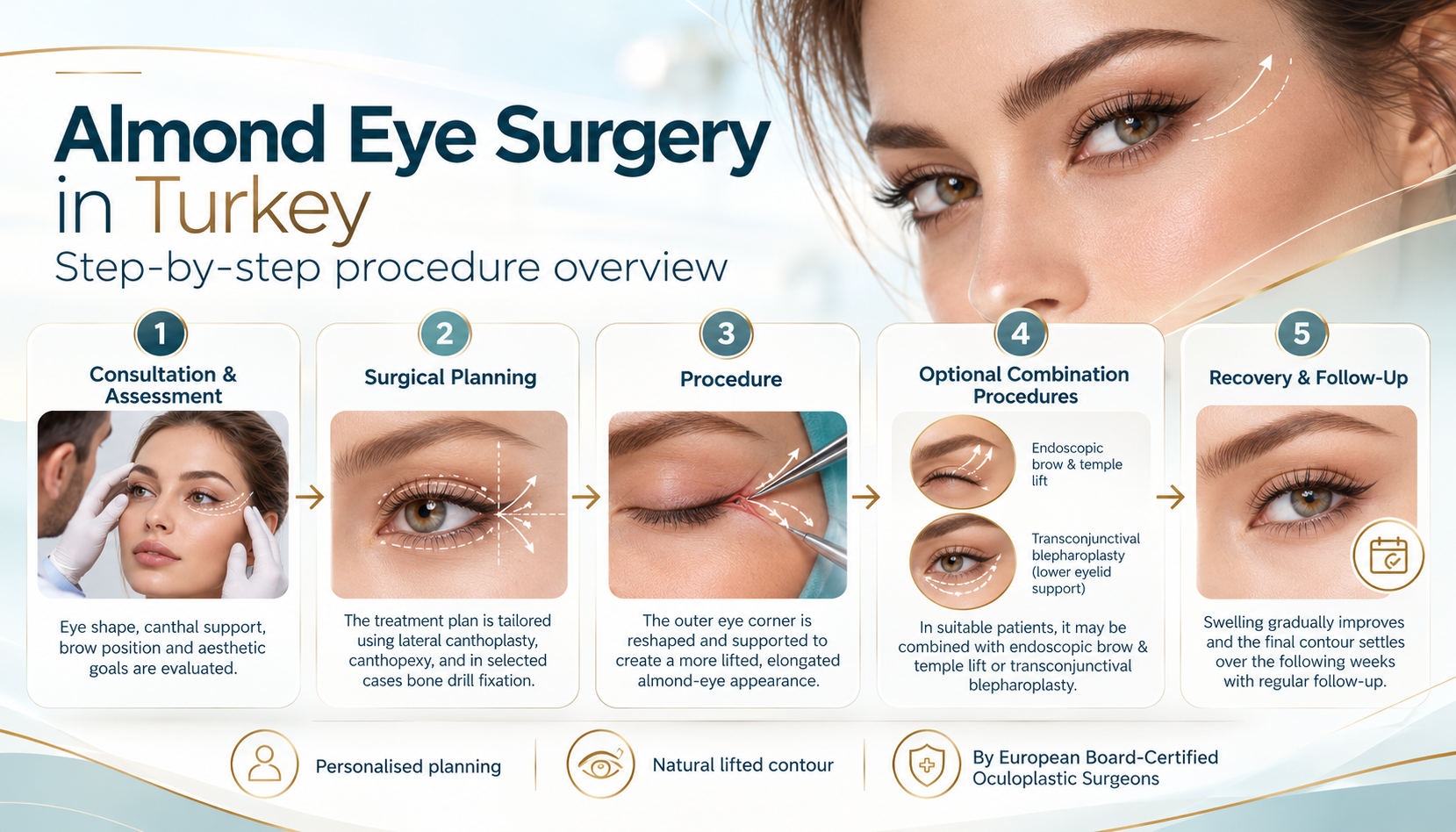
Depending on the patient’s anatomy and desired degree of lift, the procedure may involve lateral canthoplasty, canthopexy or, in selected patients, bone drill canthoplasty.
At RovithoMED, Almond Eye Surgery in Turkey is planned individually because not every patient needs the same technique. Some patients require only lateral eyelid support, while others may benefit from additional temporal or brow support.
The procedure may also be referred to as Cat Eye Surgery, Fox Eye Surgery or Hunter Eyes Surgery, although these terms can describe slightly different aesthetic goals.
What Is Almond Eye Surgery?
Almond Eye Surgery is performed to improve the shape, support and position of the outer corner of the eye.
The aim is not simply to pull the eyes upward. A well-planned procedure takes into account:
- Natural lateral canthal position
- Upper and lower eyelid support
- Existing eye tilt
- Eye prominence
- Lower eyelid laxity
- Brow and temple position
- Facial proportions
- Desired degree of elongation
For this reason, Almond Eye Surgery in Turkey should be planned according to anatomy rather than using one standard technique for every patient.
Almond Eye Surgery in Turkey may therefore involve different surgical approaches depending on the patient’s existing eye shape, eyelid support and desired aesthetic outcome.
Almond Eye Surgery Procedure
The exact Almond Eye Surgery procedure depends on the patient’s eyelid structure and aesthetic goals.During Almond Eye Surgery in Turkey, the surgical plan is tailored to the individual anatomy rather than applying the same technique to every patient.
Lateral Canthoplasty
Lateral canthoplasty involves reshaping and repositioning the outer corner of the eye.
The lateral canthal structures may be released, adjusted and fixed in a new position to create a more defined and elongated eye shape.
It may be considered in patients with:
- Negative or neutral eye tilt
- Rounded outer eye corners
- Lower eyelid laxity
- Previous eyelid surgery
- A desire for greater lateral elongation
In Almond Eye Surgery in Turkey, lateral canthoplasty may be preferred when greater structural support or a more noticeable change in the lateral eye position is required.
Canthopexy
Canthopexy is generally a more conservative technique.
Rather than extensively reconstructing the outer eyelid corner, the existing structures are supported and secured to improve stability.
It may be suitable for patients who need:
- Mild lateral elevation
- Additional eyelid support
- A subtle change
- Protection against lower eyelid laxity
In some patients, lateral canthoplasty and canthopexy can be combined.For selected patients undergoing Almond Eye Surgery in Turkey, canthopexy may provide sufficient support when extensive repositioning of the outer eye corner is not necessary.
Bone Drill Canthoplasty
In selected cases, stronger fixation may be required.
Bone drill canthoplasty uses a carefully planned bony anchoring point around the lateral orbital rim to provide stronger structural support.
This technique may be considered in patients who require:
- Greater lateral repositioning
- Revision canthoplasty
- Stronger structural fixation
- More advanced correction
- Additional support after previous surgery
Bone drill canthoplasty is not required for every patient.
Cat Eye, Fox Eye and Hunter Eyes: What Is the Difference?
The terms Cat Eye, Fox Eye and Hunter Eyes are frequently used online, but they do not always describe the same surgical plan.
Cat Eye Surgery
Cat Eye Surgery usually refers to a more lifted and elongated outer eye corner.
The result is often associated with a more feminine and elevated eye shape.
Fox Eye Surgery
Fox Eye Surgery generally describes a more pronounced upward and outward direction of the lateral eye and brow.
In some patients, the desired Fox Eye appearance may require not only canthal surgery but also temporal or brow support.
Hunter Eyes Surgery
The term Hunter Eyes is more commonly used in male patients.
The desired result is usually a more horizontal, deep-set and structurally supported eye shape rather than a highly elevated outer corner.
Hunter Eyes surgery may involve:
- Lateral canthoplasty
- Canthopexy
- Lower eyelid support
- Temporal support
- Brow-position adjustment in selected patients
Does Almond Eye Surgery Require a Brow or Temporal Lift?
No.
Patients do not automatically need an endoscopic brow lift or temporal lift when undergoing Almond Eye Surgery.
For some patients, lateral canthoplasty and/or canthopexy alone may provide the desired result.
However, if the lateral brow and temple are low or heavy, treating only the eye corner may not create a balanced appearance.
This is why some patients benefit from additional temporal support.

Almond Eye Surgery with Endoscopic Brow and Temporal Lift
In selected patients, Almond Eye Surgery can be combined with an endoscopic brow and temporal lift.
This combination may be appropriate when the patient has:
- Low lateral brow position
- Temporal tissue descent
- Heavy outer upper eyelid tissue
- Significant negative eye tilt
- A desire for a more pronounced Fox Eye effect
- A need for wider structural support
The endoscopic lift supports the brow and temple, while canthoplasty or canthopexy addresses the outer eye corner.
This combined approach may provide a more harmonious result when both the eyelid and surrounding tissues require repositioning.
However, it is not mandatory for every patient.
Why Is Temporal Support Important in Some Patients?
The eyelid, lateral brow and temple form one aesthetic unit.
If the eye corner is lifted but the surrounding temporal tissues remain low, the result may appear unbalanced.
Supporting the lateral eye from the temporal region can help distribute tension more naturally and reduce excessive direct pulling on the eyelid.
For this reason, temporal support may improve both stability and aesthetic balance in selected patients.
Can Almond Eye Surgery Be Combined with Transconjunctival Blepharoplasty?
Yes.
Almond Eye Surgery in Turkey can be combined with transconjunctival lower blepharoplasty when the patient also has lower eyelid bags or prominent fat pads.
Transconjunctival blepharoplasty is performed through the inside of the lower eyelid, avoiding an external skin incision for fat treatment.
This combination may be considered in patients with:
- Lower eyelid bags
- Under-eye puffiness
- Rounded eye shape
- Lower eyelid laxity
- Negative eye tilt
- Combined lower eyelid and canthal concerns
How Much Can the Eyes Be Lifted?
The degree of lift varies from patient to patient.
Some patients want a subtle almond shape, while others prefer a more pronounced Cat Eye or Fox Eye appearance.
The achievable degree of lift depends on:
- Existing eye tilt
- Eyelid length
- Orbital anatomy
- Lower eyelid laxity
- Brow position
- Eye prominence
- Skin quality
- Previous surgery
A reference photograph can help communicate aesthetic goals, but the final result must be adapted to the patient’s own anatomy.
Is Almond Eye Surgery Permanent?
Almond Eye Surgery provides a structural and long-lasting change.
However, no facial surgery can completely stop the natural ageing process.
Long-term stability may be influenced by:
- Skin elasticity
- Tissue quality
- Age
- Genetics
- Brow and temporal ageing
- Previous eyelid surgery
- Degree of initial correction
Canthoplasty creates structural repositioning, while canthopexy provides additional support.
In appropriately selected patients, results may remain stable for many years.
Almond Eye Surgery Recovery
Recovery depends on the technique used and whether additional procedures are performed.Recovery after Almond Eye Surgery in Turkey varies according to the technique performed and whether the surgery is combined with other eyelid or brow procedures.
During the first days, patients may experience:
- Swelling
- Bruising
- Tightness around the outer eye
- Mild tenderness
- Temporary asymmetry
If the procedure is combined with an endoscopic brow and temporal lift, swelling may involve a larger area and recovery may take longer.
The final eye shape becomes clearer as swelling gradually decreases.
Almond Eye Surgery Recovery Timeline
First Week
Swelling and bruising are usually most noticeable during the early recovery period.
The patient should avoid rubbing the eyes and follow all post-operative instructions carefully.
First Few Weeks
The eye area gradually becomes softer and more natural.
Temporary asymmetry may improve as swelling resolves.
Long-Term Healing
The final contour continues to settle over the following months.
Healing time varies according to the procedure, anatomy and individual tissue response.
Almond Eye Surgery Prices in Turkey
The cost of Almond Eye Surgery in Turkey depends on the technique required and whether additional procedures are included.
Lateral Canthoplasty and Canthopexy Price
A lateral canthoplasty and canthopexy combination generally costs approximately:
€4,000 – €5,000
The final price may vary depending on surgical complexity and whether stronger fixation methods are required.
Almond Eye Surgery with Endoscopic Brow and Temporal Lift Price
If an endoscopic brow and temporal lift is added, the total treatment cost may increase to approximately:
€7,500 – €8,500
The final price depends on:
- Eyelid anatomy
- Surgical complexity
- Required fixation technique
- Previous operations
- Whether brow and temporal lifting is added
- Additional procedures such as transconjunctival blepharoplasty
Why Is Surgeon Selection Important?
Canthal surgery involves a small but functionally important anatomical area.
Overcorrection or inappropriate fixation can potentially affect:
- Eyelid closure
- Lower eyelid position
- Tear distribution
- Eye comfort
- Symmetry
- Natural facial expression
For this reason, choosing a surgeon with specific experience in eyelid and periocular surgery is important.
An European Board-certified oculoplastic surgeon has specialist training in eyelid, orbital and periocular procedures.
Before surgery, the surgeon should assess:
- Lateral canthal tendon anatomy
- Lower eyelid laxity
- Eye prominence
- Tear film and ocular surface
- Existing eye tilt
- Brow position
- Orbital rim anatomy
- Previous surgery
- Eyelid symmetry
At RovithoMED, Almond Eye Surgery treatment plans are created with experienced oculoplastic surgeons, including European Board-certified specialists.
Who Is a Good Candidate for Almond Eye Surgery?
Suitable candidates may include patients with:
- Neutral or negative lateral eye tilt
- Rounded outer eye corners
- Lower eyelid laxity
- Desire for greater eye elongation
- Eye asymmetry
- Previous canthal surgery
- Aesthetic goals such as Cat Eyes, Fox Eyes or Hunter Eyes
Patients should also have realistic expectations.
Not every eye shape can safely be transformed into the same result.
Frequently Asked Questions
Is Almond Eye Surgery the same as Cat Eye Surgery?
The terms are often used interchangeably, but they are not always identical. Almond Eye Surgery usually aims for a balanced almond shape, while Cat Eye Surgery may involve more pronounced lateral elevation.
Is Fox Eye Surgery different from Almond Eye Surgery?
Fox Eye Surgery generally refers to a more elevated lateral eye and brow appearance. Some patients may need temporal or brow lifting in addition to canthal surgery.
What are Hunter Eyes?
Hunter Eyes is an aesthetic term commonly used in male patients. It generally refers to a more horizontally elongated and structurally supported eye contour.
Do I need an endoscopic brow lift with Almond Eye Surgery?
No. Brow and temporal lifting are not required for every patient. Some patients achieve an appropriate result with lateral canthoplasty and/or canthopexy alone.
What is the difference between canthoplasty and canthopexy?
Canthoplasty involves more extensive reshaping and repositioning of the lateral canthal structures. Canthopexy is generally more conservative and focuses on support.
What is bone drill canthoplasty?
Bone drill canthoplasty uses a bony fixation point to create stronger structural support. It is reserved for selected patients and is not routinely necessary.
Can Almond Eye Surgery be combined with lower blepharoplasty?
Yes. It can be combined with transconjunctival lower blepharoplasty in patients who also have lower eyelid bags or prominent fat pads.
How permanent is Almond Eye Surgery?
The result is long-lasting, but natural ageing continues. Some tissue relaxation may occur over the years.
How much does Almond Eye Surgery cost in Turkey?
Lateral canthoplasty and canthopexy generally cost around €4,000–€5,000. When an endoscopic brow and temporal lift is added, the total cost may increase to approximately €7,500–€8,500.
Why choose an oculoplastic surgeon?
Because the procedure directly involves eyelid anatomy and function, an experienced European Board-certified oculoplastic surgeon can evaluate both aesthetic goals and functional safety.


