


Direct Brow Lift Scars: How Long Do They Take to Fade?

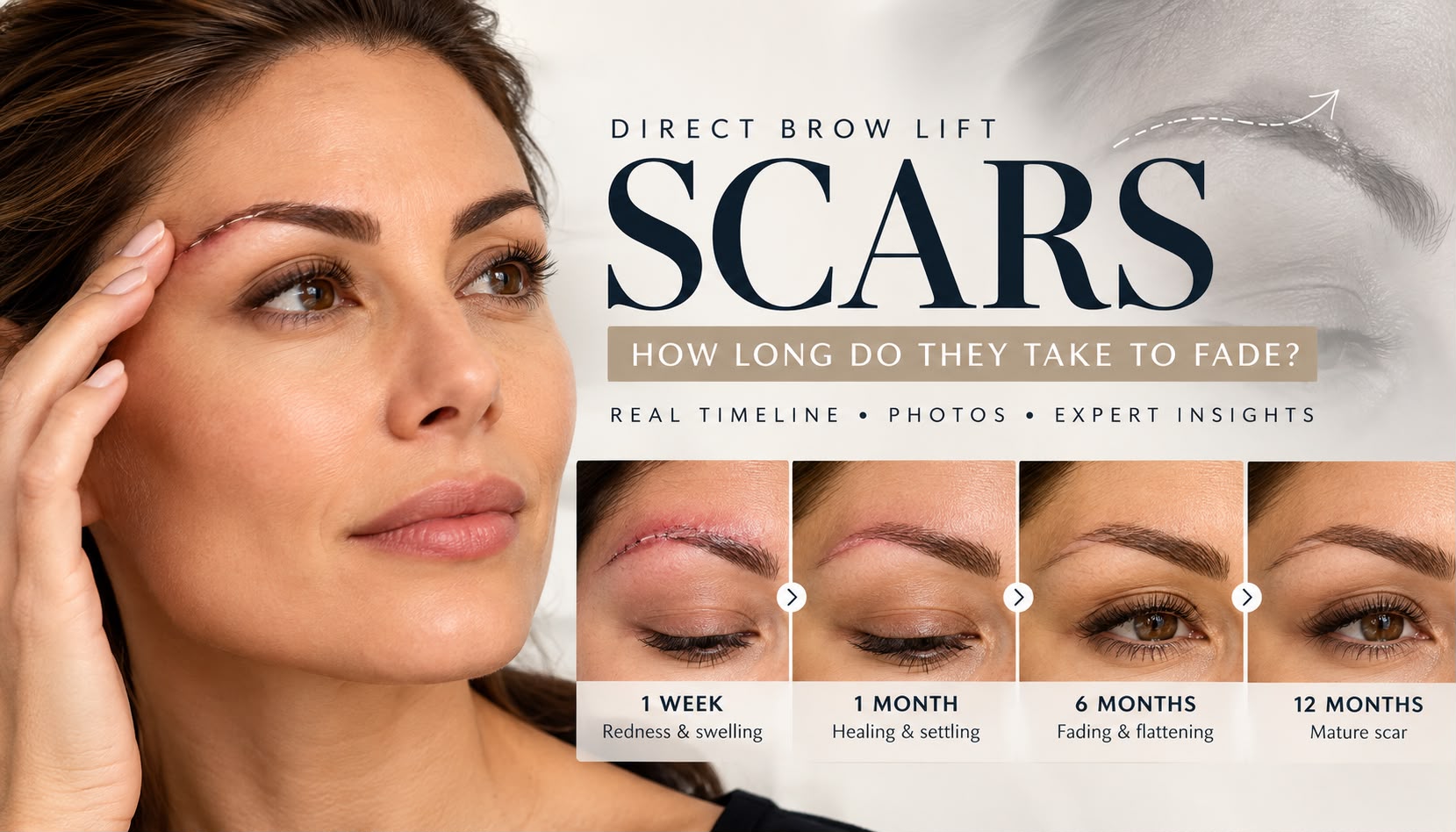
Direct brow lift scars are placed immediately along or just above the upper border of the eyebrow. In the early healing period, the incision may appear pink, red, or more noticeable than expected. Over the following months, the scar generally softens, flattens, and becomes less conspicuous, although the final appearance and maturation time vary from patient to patient.
One of the most common questions patients ask before a direct brow lift is not about the amount of lift—it is about the scar.
This concern is understandable. Unlike an endoscopic brow lift, where incisions are usually hidden within the hair-bearing scalp, a direct brow lift requires an incision close to the eyebrow itself.
However, scar appearance is influenced by much more than simply where the incision is placed. Surgical technique, closure tension, eyebrow density, individual healing characteristics, postoperative care, and time can all affect how noticeable the final scar becomes.
Recent research continues to support the direct brow lift as an effective technique for precise correction of brow ptosis, while also showing that patient perception of the scar can improve over time.
Where Is the Scar After a Direct Brow Lift?
In a direct brow lift, the incision is generally positioned immediately along or just above the superior border of the eyebrow.
This location allows the surgeon to directly control the height, contour, and symmetry of the eyebrow. It is one of the reasons the technique can provide very precise correction of brow ptosis.
The trade-off is that the incision is not hidden inside the scalp.
For this reason, scar placement and meticulous closure are particularly important in direct brow lift surgery.
Modern surgical approaches may use techniques designed to preserve eyebrow follicles, reduce tension on the wound and allow eyebrow hairs to provide some natural camouflage as healing progresses. A 2026 literature review found several technical factors associated with less conspicuous scarring, including appropriate incision beveling, limited undermining, deeper fixation and layered closure.
How Long Do Direct Brow Lift Scars Take to Fade?
There is no exact date on which a surgical scar suddenly disappears.
Scar maturation is a gradual biological process, and the appearance can continue changing for many months.
First 1–2 Weeks
The incision is still in the early healing phase.
Redness, swelling, bruising and a clearly visible incision line should not be confused with the final appearance of the scar.
Patients should therefore avoid judging the cosmetic result during this period.
Weeks 3–6
As the initial healing progresses, swelling generally decreases and the incision begins to settle.
The scar can still appear pink or more noticeable than the surrounding skin.
This is still an early stage of scar maturation.
Months 2–6
The scar generally continues to soften and flatten.
Its colour and texture can gradually become less prominent, although the rate of improvement differs considerably between individuals.
Months 6–12
Scar maturation continues over the longer term.
This is why comparing an early postoperative photograph with a photograph several months after surgery can give a much more realistic understanding of direct brow lift scarring.
Importantly, a scar should never be promised to become completely invisible. The objective is to achieve a well-positioned, fine and as inconspicuous a scar as reasonably possible.
Prospective research published in 2026 evaluating patients up to 12 months after direct brow lift found that patients’ perception of their scars improved over time.
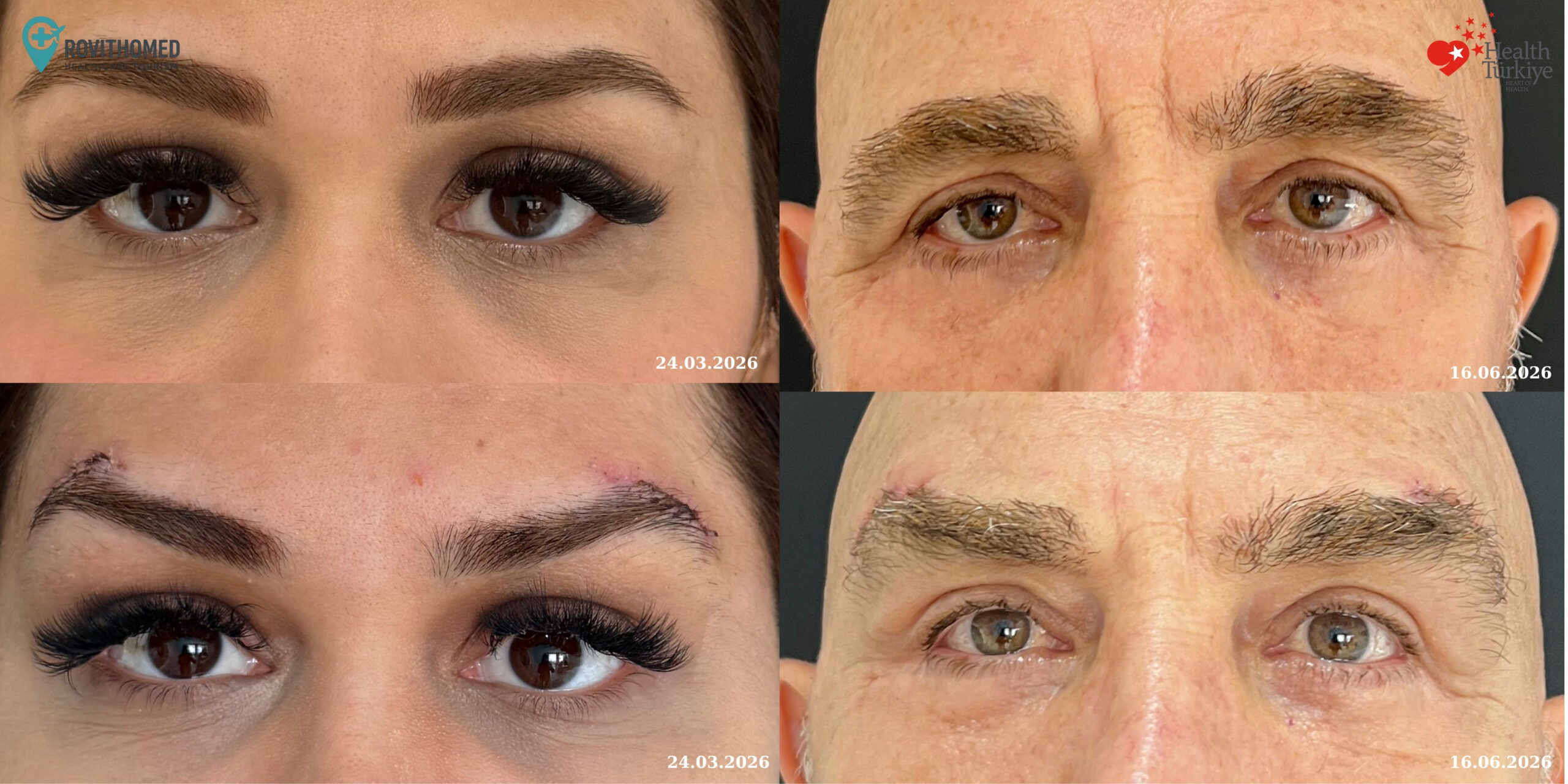
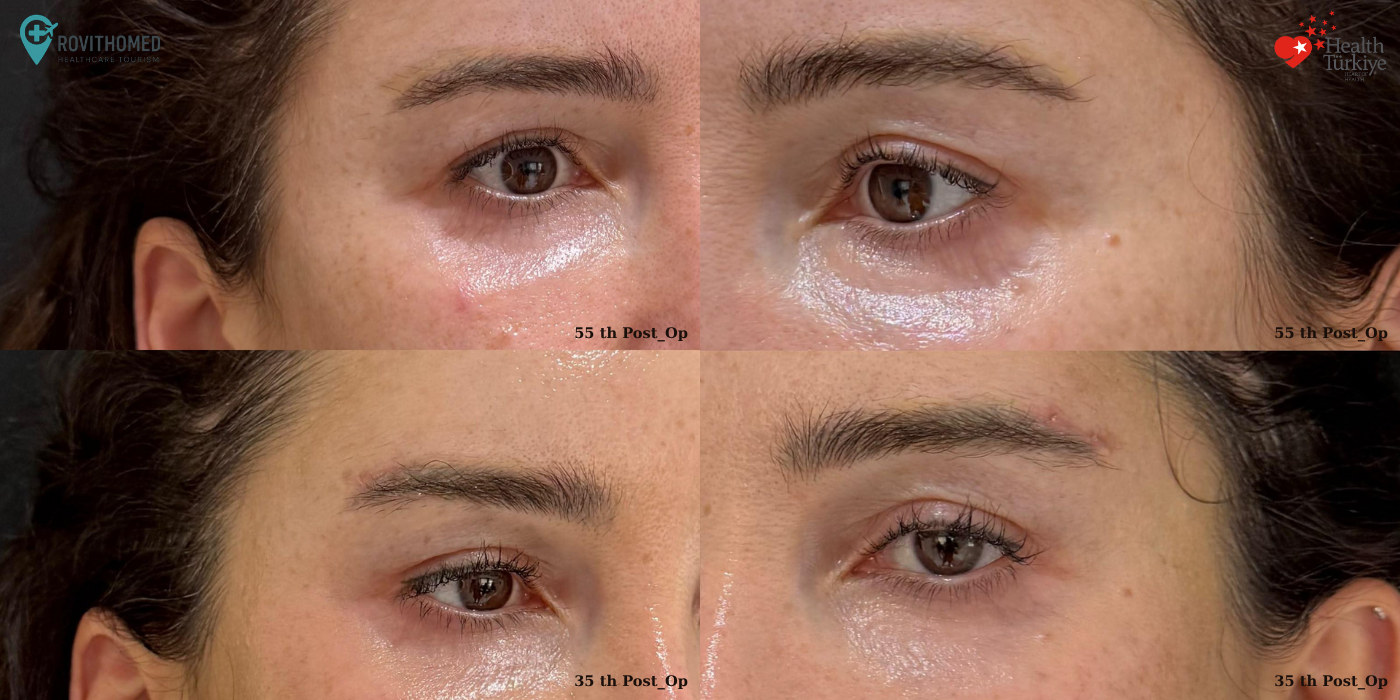
Direct Brow Lift Scars Before and After Healing
When looking at direct brow lift before-and-after photographs, timing matters.
A photograph taken several days or weeks after surgery cannot fairly represent the final scar.
Ideally, patients researching this procedure should look for photographs from different stages of recovery rather than only immediately postoperative images.
Useful comparisons may include:
* Early postoperative healing
* 1–3 month scar appearance
* 6 month results
* Longer-term results around 12 months
This provides a much more realistic picture of how the eyebrow incision changes with time.
Why Are Some Direct Brow Lift Scars More Visible Than Others?
Not every patient heals in exactly the same way.
Scar visibility can be influenced by individual healing biology, skin characteristics, previous scars, eyebrow hair density, incision position, tension across the wound and surgical closure technique.
This also explains why photographs found online should not be interpreted as a guarantee of how another patient’s scar will heal.
Published evidence indicates that careful incision design and wound closure can substantially influence scar quality.
Can the Scar Be Hidden in the Eyebrow?
To some extent, eyebrow hair can help camouflage the incision.
Modern techniques may also aim to preserve follicles near the incision so that hair growth contributes to camouflage.
However, this varies from patient to patient.
Someone with dense eyebrows may have different scar camouflage from someone with thin or sparse eyebrow hair.
For this reason, eyebrow anatomy should be evaluated before deciding whether a direct brow lift is the most appropriate technique.
Direct Brow Lift vs Endoscopic Brow Lift: What About Scars?
This is an important distinction.
An endoscopic brow lift typically places small incisions within the scalp, making their location fundamentally different from a direct brow lift incision.
A direct brow lift, by contrast, places the incision close to the eyebrow.
Why would someone choose a direct technique?
Because it provides the surgeon with very direct control over brow height, shape and asymmetry. Contemporary literature continues to describe this precision as one of the principal advantages of the technique.
Therefore, the decision should not simply be:
“Which operation has the smallest scar?”
It should be:
“Which technique best addresses my eyebrow position and anatomy while providing an acceptable balance between correction and scar placement?”
Can Direct Brow Lift Be Combined With Upper Blepharoplasty?
Yes, in appropriately selected patients.
Brow ptosis and excess upper-eyelid skin are separate anatomical problems, although they can occur together.
If the eyebrow itself is low, removing eyelid skin alone does not necessarily correct the position of the brow.
For patients who have both brow descent and excess upper-eyelid skin, a surgeon may therefore consider combining brow lifting with upper blepharoplasty.
Interestingly, in a recent prospective direct brow lift study, 35 of the 41 patients also underwent upper blepharoplasty.
The appropriate combination should always be determined through individual clinical assessment.
Direct Brow Lift Scar Assessment at RovithoMed
At RovithoMed, patients considering direct brow lift surgery in Turkey are encouraged to evaluate more than simply the immediate lifting effect.
Scar location, eyebrow density, existing asymmetry, degree of brow ptosis, previous eyelid or brow surgery and the patient’s individual expectations should all form part of treatment planning.
For international patients in particular, realistic information about recovery is important before arranging flights and accommodation.
Patients considering the procedure can also read our complete Direct Brow Lift Surgery in Turkey guide for information about candidacy, surgical planning, recovery and treatment options.
How Can You Help a Direct Brow Lift Scar Heal Well?
Postoperative instructions should always be individualized by the treating surgeon.
In general, protecting a healing incision from unnecessary trauma and sun exposure and following the surgeon’s wound-care instructions are important.
Patients should also avoid experimenting with scar products or treatments too early without discussing them with their surgical team.
Scar-management options can differ depending on the stage of healing and the characteristics of the scar. Current literature has examined approaches including surgical technique, selected laser treatments and other postoperative measures, although the evidence is not equally strong for every intervention.
Frequently Asked Questions About Direct Brow Lift Scars
Does a direct brow lift leave a scar?
Yes. A direct brow lift requires an incision along or immediately above the eyebrow, so a surgical scar is unavoidable. The objective is to position and close the incision carefully so that the mature scar becomes as inconspicuous as possible.
Are direct brow lift scars permanent?
All surgical incisions create a permanent scar at a biological level. However, the appearance of a scar can change considerably as it matures and may become much less noticeable with time.
How long does a direct brow lift scar take to heal?
Initial wound healing occurs much earlier than final scar maturation. The appearance of the scar can continue changing for many months, which is why early postoperative appearance should not be considered the final result.
Can eyebrow hair hide a direct brow lift scar?
It can provide camouflage in some patients, particularly when eyebrow hair is sufficiently dense and follicles around the incision are preserved. The degree of camouflage varies individually.
Is a direct brow lift better than an endoscopic brow lift?
Neither technique is universally better. They have different incision locations, indications and advantages. The appropriate procedure depends on brow position, anatomy, desired correction, previous surgery and the patient’s priorities regarding scar placement.
Final Thoughts
Concern about scarring is completely reasonable when considering a direct brow lift.
The procedure deliberately places an incision close to the eyebrow in exchange for very precise control of eyebrow position and contour. Modern surgical techniques aim to make that scar as inconspicuous as possible, but individual healing remains an important variable. Current evidence suggests that scar perception generally improves over time and that refined surgical techniques can substantially reduce scar conspicuity.
For this reason, patients should evaluate long-term results rather than judging a direct brow lift from photographs taken during the first few weeks of recovery.
Frequently Asked Questions About Direct Brow Lift Scars
1. Does a direct brow lift leave a visible scar?
A direct brow lift creates an incision close to the eyebrow, so a scar is expected. In many patients, it gradually becomes less noticeable as healing progresses.
2. Where is the scar located after a direct brow lift?
The scar is usually placed along or just above the upper border of the eyebrow, where it can blend with the natural brow line.
3. How long does a direct brow lift scar take to fade?
Scar maturation commonly takes several months. The appearance may continue to improve for up to a year or longer.
4. What does a direct brow lift scar look like during healing?
At first, the scar may appear pink, red, or slightly raised. It usually becomes flatter and lighter over time.
5. Can direct brow lift scars be hidden with makeup?
Once the incision has fully healed and your surgeon approves it, makeup can usually be used to help camouflage the scar.
6. Are direct brow lift scars permanent?
Yes. Every surgical incision leaves a permanent scar, but well-healed scars can become very subtle and difficult to notice.
7. What affects how well a direct brow lift scar heals?
Skin type, genetics, sun exposure, smoking, wound care, and individual scar tendency can all influence the final appearance.
8. Can a direct brow lift scar become thick or raised?
It is possible, especially in patients who are prone to hypertrophic or prominent scarring.
9. Can a direct brow lift scar be revised later?
Yes. If a scar remains noticeable after full healing, treatments such as laser, injections, or surgical scar revision may be considered.
10. How can I make my direct brow lift scar less noticeable?
Follow your surgeon’s aftercare instructions, protect the scar from the sun, and use recommended scar treatments during the healing period.


