
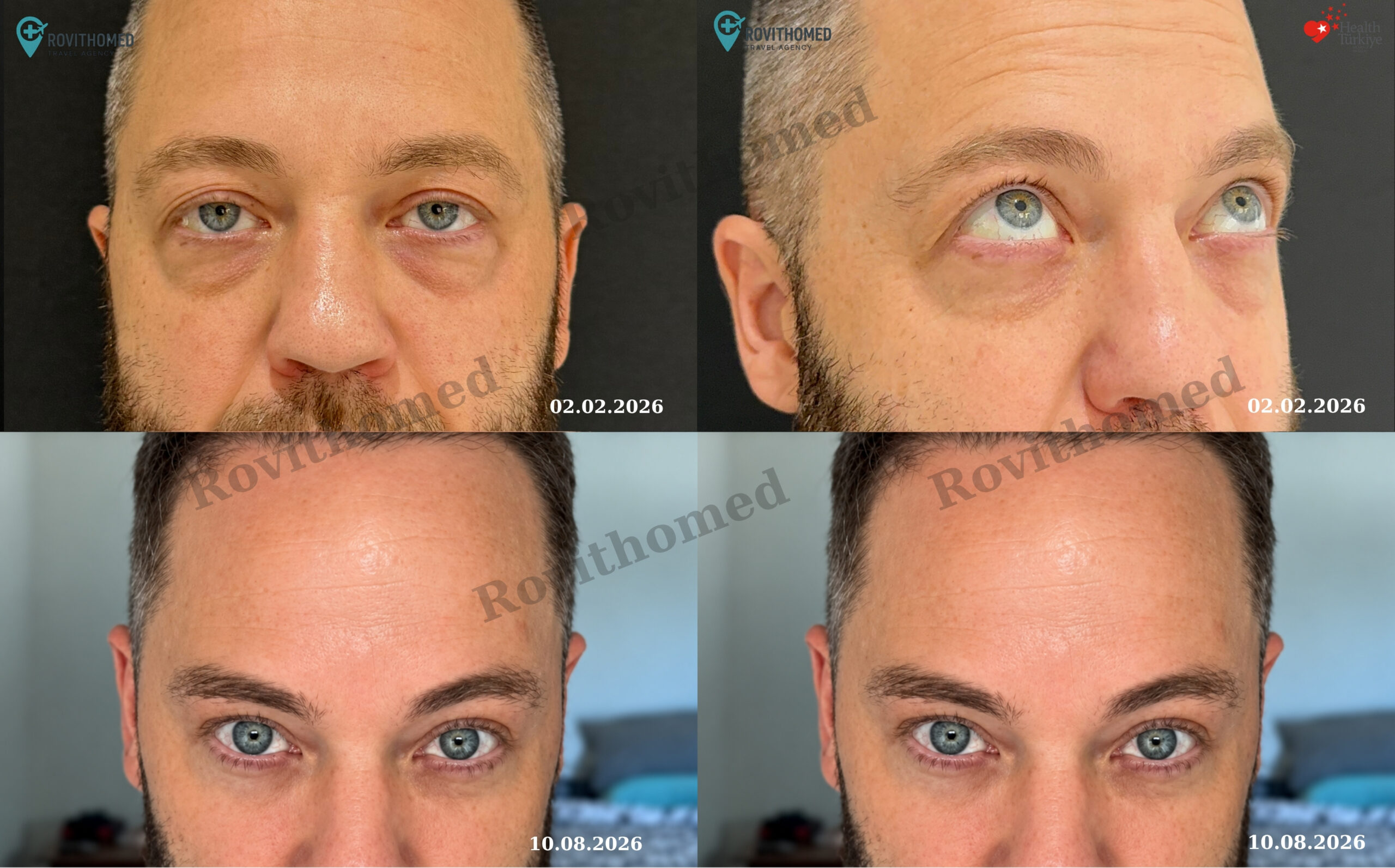
Hunter Eye Surgery in Turkey: Cost, Techniques & Results
Hunter Eye Surgery in Turkey is a personalized oculoplastic treatment designed to create a more defined, horizontally elongated, and well-supported eye shape.
Rather than referring to one single surgical technique, Hunter Eye Surgery usually involves a customized combination of procedures selected according to the patient's natural eye shape, eyelid support, brow position, canthal tilt, and overall facial anatomy.
At Rovithomed, international patients seeking Hunter Eye Surgery in Istanbul are evaluated individually, and their treatment plans are coordinated according to their anatomical needs and aesthetic goals.
Hunter Eye Surgery patients referred through Rovithomed are evaluated and treated by Op. Dr. Yıldız Acar Ebcim, MD, FEBO, an ophthalmologist whose clinical practice has a strong focus on oculoplastic and periocular surgery.
The goal is not to create exactly the same eye shape in every patient. Instead, treatment aims to achieve a sharper, more structured, and naturally balanced eye appearance while respecting each patient's facial proportions.
What Is Hunter Eye Surgery?
Hunter Eye Surgery is an aesthetic surgical approach designed to modify the relationship between the outer corner of the eye, eyelids, eyebrows, and temporal region.
The term “hunter eyes” generally describes eyes with a more horizontal and elongated appearance, good lower eyelid support, limited scleral show, and a neutral or positive canthal tilt.
Depending on the patient's existing anatomy, achieving this appearance may require treatment of several different anatomical structures rather than changing only the outer corner of the eye.
For this reason, Hunter Eye Surgery may include:
Lateral canthoplasty
Canthopexy
Endoscopic brow lift
Endoscopic temporal lift
Upper blepharoplasty
Lower blepharoplasty
Lower eyelid support procedures when required
Not every patient needs all of these procedures.
The surgical plan should be customized after evaluating the patient's eyes, eyelids, brow position, facial structure, and desired result.
What Do Hunter Eyes Mean?
In facial aesthetics, the term “hunter eyes” is commonly used to describe an eye shape characterized by several anatomical features.
These may include:
A horizontal or horizontally elongated eye shape
Neutral or positive canthal tilt
Good support of the lower eyelid
Minimal scleral show beneath the iris
Defined lateral eye corners
A balanced distance between the eyebrows and eyes
A relatively structured and focused appearance
These characteristics may create a sharper and more defined gaze.
However, there is no single medically standardized “hunter eye shape” that should be reproduced in every patient.
Facial bone structure, orbital anatomy, eyelid position, eyebrow height, eye prominence, and skin quality vary considerably between individuals.
Therefore, the ideal result should always be adapted to the patient's natural anatomy.
How Is Hunter Eye Surgery Performed?
Hunter Eye Surgery is usually performed using a combination of surgical techniques.
The exact procedure depends on which anatomical structures are responsible for the patient's current eye shape.
Some patients primarily require modification of the lateral canthus, while others may benefit from additional treatment of the eyebrow, temple, upper eyelid, or lower eyelid.
A detailed assessment is therefore essential before determining the surgical plan.
Lateral Canthoplasty
Lateral canthoplasty is a surgical technique involving the outer corner of the eye.
It can be used to reshape, reposition, reconstruct, or support the lateral canthus depending on the patient's anatomy.
When appropriate, the procedure can help:
Improve the position of the outer corner of the eye
Create a more positive canthal tilt
Improve lateral eyelid support
Produce a more elongated eye appearance
Improve the relationship between the upper and lower eyelids
The exact canthoplasty technique should be selected according to eyelid anatomy and support.
Canthopexy
Canthopexy is another technique used to support the lateral corner of the eye.
Unlike more extensive canthoplasty procedures, canthopexy generally reinforces or repositions the existing lateral canthal structures without completely reconstructing them.
It may be suitable for patients requiring:
Mild lateral elevation
Additional eyelid support
Stabilization of the outer eye corner
Prevention of lower eyelid descent
In some Hunter Eye Surgery patients, canthopexy may be combined with other procedures to create a more balanced result.

When Is a Midface Lift Combined with Hunter Eye Surgery?
In some patients, achieving a balanced Hunter Eye appearance requires more than reshaping the outer corner of the eye or lifting the brow and temple.
The position of the midface and upper cheek tissues can also have a significant effect on the appearance of the lower eyelid and the overall eye contour.
When the midface has descended, the lower eyelid–cheek transition may appear longer, flatter, or less supported. This can reduce the visual effect of lateral canthal surgery and may prevent the eye area from looking as structured as desired.
In these patients, a midface lift may be combined with Hunter Eye Surgery.
The midface lift helps reposition the soft tissues of the upper cheek and can improve support beneath the lower eyelid. When combined with procedures such as lateral canthoplasty, canthopexy, or endoscopic brow and temporal lifting, it can create a more harmonious transition between the eyes, lower eyelids, and cheek area.
A combined treatment may be considered in patients with:
Midface descent
Flattening of the upper cheek
A long or poorly supported lower eyelid–cheek junction
Lower eyelid laxity
Prominent tear trough or lid–cheek transition
Malar bags
Previous eyelid surgery with inadequate midface support
A need for more comprehensive periocular rejuvenation
Not every Hunter Eye patient requires a midface lift.
In younger patients with good cheek support and a stable lower eyelid, treatment may be limited to the lateral canthus, brow, temple, or eyelids.
However, when the lower eyelid and cheek position contribute significantly to the overall eye shape, treating the midface at the same time may provide a more balanced and structurally supported result.
The decision is made after evaluating the lateral canthus, lower eyelid, cheek position, orbital anatomy, and facial proportions together rather than assessing the eye area in isolation.
Endoscopic Brow and Temporal Lift
The position of the eyebrow and temple can significantly influence the apparent shape of the eyes.
For this reason, changing only the outer corner of the eye may not always be sufficient.
An endoscopic brow and temporal lift can reposition the lateral eyebrow and temporal tissues, creating a more supported and elevated frame around the eyes.
This procedure may help:
Elevate a low lateral eyebrow
Improve temporal descent
Reduce heaviness around the outer upper eyelid
Improve the brow-to-eye relationship
Enhance the effect of lateral canthal surgery
For patients seeking a more comprehensive Hunter Eye appearance, lateral canthal surgery and endoscopic brow-temporal lifting may therefore be combined.
Upper Blepharoplasty and Hunter Eye Surgery
Upper blepharoplasty may be included when excess upper eyelid skin contributes to a heavy or tired appearance.
The procedure removes or repositions selected tissues of the upper eyelid while preserving appropriate eyelid function and natural proportions.
When combined with Hunter Eye Surgery, upper blepharoplasty may help improve:
Upper eyelid definition
Excess skin
Lateral hooding
Eyelid symmetry
The overall relationship between the eyebrow and upper eyelid
Upper blepharoplasty is not automatically required for every Hunter Eye patient.
In younger patients with little or no excess skin, other techniques may be sufficient.
Lower Blepharoplasty and Hunter Eye Surgery
Lower eyelid anatomy is particularly important when creating a structured eye shape.
Weak lower eyelid support, prominent eye bags, scleral show, or lower eyelid laxity may affect the overall appearance of the eyes.
Lower blepharoplasty or additional lower eyelid support procedures may therefore be recommended in selected patients.
The goal is not simply to remove fat but to improve the relationship between the lower eyelid, lateral canthus, and cheek while maintaining appropriate eyelid function.
Is Hunter Eye Surgery the Same for Everyone?
No.
Hunter Eye Surgery should never be considered a standardized operation performed identically on every patient.
One patient may require only lateral canthal surgery, while another may need a combination of:
Lateral canthoplasty + canthopexy + endoscopic brow and temporal lift.
Another patient may additionally require:
Upper blepharoplasty or lower blepharoplasty.
The correct treatment depends on factors such as:
Natural eye shape
Canthal tilt
Lower eyelid support
Upper eyelid skin
Eye prominence
Facial bone structure
Temporal tissue position
Facial asymmetry
Previous eyelid surgery
Desired aesthetic result
A personalized oculoplastic evaluation is therefore essential.
Hunter Eyes vs. Prey Eyes
The terms “hunter eyes” and “prey eyes” are popular aesthetic descriptions rather than formal medical diagnoses.
They are commonly used online to describe different eye shapes.
| Feature | Hunter Eyes | Prey Eyes |
|---|---|---|
| Eye shape | More horizontal / elongated | More rounded |
| Canthal tilt | Neutral or positive | Neutral or negative |
| Lower eyelid | More supported | Greater scleral visibility may occur |
| Overall appearance | Defined and structured | Softer and rounder |
| Outer eye corner | More supported or elevated | May appear more downward |
These descriptions should not be interpreted as medical standards of attractiveness.
The most appropriate eye shape depends on the patient's individual facial anatomy and proportions.
Who Is a Good Candidate for Hunter Eye Surgery?
Hunter Eye Surgery may be considered by patients who would like to improve the shape or support of the eye area.
Potential candidates may have:
Downward-slanting outer eye corners
Neutral or negative canthal tilt
Weak lateral eyelid support
Lower eyelid laxity
Excess upper eyelid skin
Low lateral eyebrow position
Temporal descent
Tired-looking eyes
Limited definition around the eyes
Facial asymmetry involving the eyelids or eyebrows
It may also appeal to patients who prefer a sharper, more horizontally oriented eye appearance.
However, suitability cannot be determined by aesthetic preference alone.
Eyelid function, ocular surface health, previous surgery, eye prominence, and facial anatomy should also be evaluated before surgery.
Can Men Have Hunter Eye Surgery?
Yes.
Hunter Eye Surgery can be performed for both male and female patients.
Male patients often request a more defined eye area while wanting to preserve masculine facial characteristics.
For this reason, the position and shape of the eyebrows should be carefully considered.
Excessive elevation of the eyebrow may create an appearance that does not match the patient's desired result.
Treatment should therefore be individualized according to facial structure, gender-related facial characteristics, and the patient's aesthetic goals.
What Results Can Be Expected After Hunter Eye Surgery?
Depending on the procedures performed and the patient's original anatomy, Hunter Eye Surgery may create:
A more horizontally elongated eye shape
Improved lateral canthal position
Better lower eyelid support
A more defined eye contour
Reduced heaviness of the upper eyelid
Improved brow position
A sharper and more structured gaze
Better balance between the eyes and eyebrows
Improvement in certain types of asymmetry
The objective should be improvement rather than creating an identical eye shape for every patient.
The degree of change depends significantly on pre-existing anatomy.
Can Hunter Eye Surgery Correct Asymmetry?
Hunter Eye Surgery may improve certain forms of asymmetry involving the eyebrows, eyelids, or lateral canthus.
However, almost every human face has some degree of natural asymmetry.
Surgery can improve visible differences but cannot guarantee perfect symmetry.
Patients with significant pre-existing asymmetry may require different techniques or slightly different degrees of correction on each side.
A detailed preoperative assessment is particularly important in these cases.
How Long Does Hunter Eye Surgery Take?
The duration of surgery depends on the number and complexity of procedures being performed.
A limited lateral canthal procedure is naturally different from a comprehensive treatment combining canthoplasty, brow-temporal lifting, and blepharoplasty.
For this reason, surgery time is determined after the treatment plan has been finalized.
The type of anesthesia and surgical setting are also selected according to the combination of procedures and the patient's medical requirements.
Hunter Eye Surgery Recovery
Recovery varies depending on the surgical techniques used.
A patient undergoing only a limited lateral eyelid procedure may recover differently from someone undergoing a combined endoscopic brow-temporal lift and eyelid surgery.
In general, swelling and bruising are expected during the early postoperative period.
First Few Days
Swelling, tightness, and bruising may be most noticeable during the first several days.
Temporary asymmetry can also occur because swelling does not always develop equally on both sides.
First 1–2 Weeks
Swelling and bruising generally begin to improve significantly.
Patients usually become increasingly comfortable with normal daily and social activities as healing progresses.
First Few Weeks
The eye contour and brow position gradually become easier to evaluate as swelling decreases.
However, the tissues are still healing.
Following Months
The final result develops gradually as swelling resolves and tissues settle into their new position.
Patients should therefore avoid judging the final result too early after surgery.
How Long Do Hunter Eye Surgery Results Last?
Hunter Eye Surgery is designed to create long-lasting structural changes.
Procedures such as canthoplasty, canthopexy, and endoscopic brow or temporal lifting reposition or support tissues surgically rather than creating only a temporary cosmetic effect.
Results can therefore remain visible for many years.
However, surgery cannot stop natural aging.
Over time, changes in:
Skin elasticity
Soft tissue volume
Eyebrow position
Facial fat
Bone structure
Genetics
Lifestyle
may gradually influence the appearance of the eye and brow region.
Is Hunter Eye Surgery Permanent?
The structural changes created by Hunter Eye Surgery are generally long-lasting, but describing any facial aesthetic surgery as completely permanent can be misleading.
The surgically repositioned tissues may maintain their improved position for many years, while normal aging continues around them.
For this reason, Hunter Eye Surgery should be considered a long-lasting surgical treatment rather than a procedure that permanently prevents future age-related changes.
Risks and Considerations
Like every surgical procedure, Hunter Eye Surgery involves potential risks and limitations.
Possible complications may include:
Swelling
Bruising
Temporary asymmetry
Infection
Bleeding
Scarring
Dry eye symptoms
Changes in eyelid position
Under-correction
Over-correction
Persistent asymmetry
Lower eyelid malposition
Need for revision surgery
Risk varies according to the procedure performed, previous operations, individual anatomy, medical history, and healing characteristics.
Because the eyelids have both aesthetic and functional roles, surgery around the eyes should be planned carefully.
A detailed consultation is necessary before determining whether the procedure is appropriate.
Hunter Eye Surgery Cost in Turkey
The price of Hunter Eye Surgery in Turkey depends primarily on the number and complexity of procedures required.
For 2027, comprehensive Hunter Eye Surgery in Turkey generally ranges from approximately:
€7,500 – €9,000
This range usually applies to patients requiring a combination of procedures around the lateral eye, brow, and temporal region.
The final cost may vary depending on whether the treatment plan includes:
Lateral canthoplasty
Canthopexy
Endoscopic brow lift
Endoscopic temporal lift
Upper blepharoplasty
Lower blepharoplasty
Additional eyelid support procedures
Previous eyelid surgery or revision surgery
Because the procedure is personalized, the final price can only be confirmed after the patient's anatomy and treatment requirements have been evaluated.
How Much Does Cosmetic Eye Reshaping Cost in Turkey?
Not every patient seeking cosmetic eye reshaping requires a complete Hunter Eye Surgery combination.
When treatment is mainly limited to the eyelid and lateral eye area, without an endoscopic brow or temporal procedure, cosmetic eye reshaping procedures in Turkey generally:
Start from approximately €4,000.
The final cost depends on the exact procedure required.
More comprehensive treatment involving the brow, temple, eyelids, and lateral canthus will have a higher price.
Are Discounts Available for Hunter Eye Surgery?
Reasonable discounts may be available for cash payments, depending on the individual treatment plan and payment conditions.
Any discount is confirmed together with the patient's final quotation.
Patients should therefore request an individualized price assessment rather than relying only on a standard package price.
Hunter Eye Surgery in Istanbul with Rovithomed
Rovithomed is an international health tourism agency that coordinates treatment for international patients seeking medical and aesthetic procedures in Turkey.
For patients considering Hunter Eye Surgery, Rovithomed helps coordinate the treatment process from the initial assessment through surgical planning and postoperative care.
Treatment is planned according to the patient's individual needs rather than offering one standardized Hunter Eye package.
International patients can initially provide photographs for a preliminary evaluation before traveling to Istanbul.
Following assessment, the appropriate treatment options and personalized quotation can be provided.
About Op. Dr. Yıldız Acar Ebcim, MD, FEBO
Hunter Eye Surgery patients referred through Rovithomed are evaluated and treated by Op. Dr. Yıldız Acar Ebcim, MD, FEBO.
Dr. Ebcim is an ophthalmologist with a clinical focus on oculoplastic and periocular surgery.
She graduated from Istanbul University Cerrahpaşa Faculty of Medicine and completed her specialization in ophthalmology.
Her clinical practice includes procedures such as:
Upper blepharoplasty
Lower blepharoplasty
Ptosis surgery
Lateral canthoplasty
Canthopexy
Endoscopic brow lifting
Endoscopic temporal lifting
Endoscopic midface surgery
Periocular aesthetic and reconstructive procedures
Dr. Ebcim successfully completed the International Council of Ophthalmology (ICO) Basic Science Examination in 2013.
In 2025, she obtained the European Board of Ophthalmology Diploma (FEBO) after successfully completing the European Board of Ophthalmology examination.
Her approach to Hunter Eye Surgery focuses on evaluating the entire relationship between the eyelids, lateral canthus, eyebrow, temple, and surrounding facial structures rather than treating only one anatomical area.
Why Choose Rovithomed for Hunter Eye Surgery in Turkey?
Patients considering Hunter Eye Surgery through Rovithomed benefit from an individualized treatment planning process.
The approach includes:
Personalized Surgical Planning
There is no standard Hunter Eye procedure suitable for everyone.
The treatment combination is selected according to each patient's individual anatomy.
Oculoplastic-Focused Evaluation
Because the surgery involves delicate structures around the eyes, both aesthetic appearance and eyelid function are considered during treatment planning.
International Patient Coordination
Rovithomed assists international patients with treatment coordination in Istanbul and communication throughout the treatment process.
Combined Surgical Options
When medically appropriate, several procedures can be combined during the same treatment plan, allowing the surgeon to address the eyelids, lateral canthus, eyebrows, and temporal region together.
Individual Price Assessment
Patients receive a treatment plan and quotation based on the actual procedures they require rather than a single fixed surgical package.
Frequently Asked Questions About Hunter Eye Surgery in Turkey
1. Is there surgery to get hunter eyes?
Yes.
In suitable patients, surgery can create many of the anatomical characteristics associated with a Hunter Eye appearance.
However, Hunter Eye Surgery is not one specific standardized operation.
Depending on the patient's anatomy, the surgical plan may include lateral canthoplasty, canthopexy, endoscopic brow and temporal lifting, upper blepharoplasty, lower blepharoplasty, or a combination of these procedures.
The objective is to create a more defined and horizontally balanced eye shape while preserving appropriate eyelid function and facial harmony.
2. What is the Hunter Eye aesthetic procedure?
The Hunter Eye aesthetic procedure is a customized surgical approach intended to create a more horizontal, defined, and supported appearance around the eyes.
It commonly involves a combination of lateral canthoplasty or canthopexy and endoscopic brow-temporal lifting.
Depending on the patient's anatomy, upper or lower blepharoplasty may also be added.
There is no single Hunter Eye operation that is suitable for every patient.
3. How much does Hunter Eye Surgery cost in Turkey?
For 2027, comprehensive Hunter Eye Surgery in Turkey generally costs approximately €7,500–€9,000.
The final price depends on the procedures required.
For example, a patient requiring lateral canthoplasty, canthopexy, and endoscopic brow-temporal lifting will have a different surgical plan from someone requiring additional upper or lower blepharoplasty.
A personalized quotation is therefore provided after evaluation.
4. How much does cosmetic eye reshaping cost in Turkey?
Cosmetic eye reshaping procedures that mainly involve the eyelids and lateral eye area, without surgery involving the brow or temporal region, generally start from approximately €4,000.
More comprehensive Hunter Eye Surgery involving several anatomical regions generally costs more.
5. Are there any special offers or discounts for Hunter Eye Surgery?
Reasonable discounts may be available for patients choosing cash payment.
The exact discount depends on the treatment plan and payment conditions and is confirmed with the final surgical quotation.
6. What are the top-rated clinics for Hunter Eye Surgery in Turkey?
Patients researching Hunter Eye Surgery in Turkey should look for providers working with surgeons who have specific experience in eyelid, lateral canthal, brow, and periocular surgery.
Rovithomed coordinates international patients seeking Hunter Eye Surgery in Istanbul with Op. Dr. Yıldız Acar Ebcim, MD, FEBO, whose clinical practice focuses extensively on oculoplastic and periocular procedures.
Rather than relying only on clinic rankings, patients should consider the surgeon's qualifications, experience with periocular anatomy, treatment approach, before-and-after results, and ability to create an individualized surgical plan.
7. Is getting hunter eyes possible?
Yes, many of the anatomical characteristics associated with Hunter Eyes can be created or enhanced surgically in suitable candidates.
However, the achievable result depends on the patient's existing anatomy.
Bone structure, eye prominence, eyebrow position, eyelid support, canthal tilt, facial proportions, and skin quality can all influence the final result.
The goal should therefore be to create the most appropriate version of the desired eye shape for the individual patient rather than reproducing exactly the same result in everyone.
8. How long does Hunter Eye Surgery last?
Hunter Eye Surgery creates structural changes that are designed to be long-lasting.
Canthoplasty, canthopexy, and endoscopic lifting procedures surgically reposition or support tissues, so the results can remain visible for many years.
However, normal facial aging continues after surgery.
Skin elasticity and tissue position can gradually change over time.
9. Is Hunter Eye Surgery the same as canthoplasty?
No.
Canthoplasty is one of the techniques that may be used during Hunter Eye Surgery.
Canthoplasty mainly addresses the outer corner of the eye.
Hunter Eye Surgery is a broader aesthetic concept and may involve several anatomical areas.
For example, a comprehensive treatment may combine:
Lateral canthoplasty + canthopexy + endoscopic brow and temporal lift.
Upper or lower blepharoplasty may also be added when necessary.
10. Can Hunter Eyes be achieved with canthoplasty alone?
In selected patients, canthoplasty or canthopexy alone may provide sufficient improvement in the position and shape of the outer corner of the eye.
However, this is not appropriate for everyone.
Patients with a low lateral eyebrow, temporal descent, excess upper eyelid skin, lower eyelid laxity, or other anatomical characteristics may require additional procedures.
For these patients, combining lateral canthal surgery with an endoscopic brow and temporal lift may provide a more balanced result.
Upper or lower blepharoplasty can also be included when indicated.
The entire eye, eyebrow, and temporal region should therefore be evaluated before deciding whether canthoplasty alone is sufficient.
Get a Personalized Hunter Eye Surgery Assessment
Hunter Eye Surgery should be planned according to the patient's individual facial anatomy rather than based on a standard technique or a single reference photograph.
To receive a preliminary assessment, international patients can provide clear photographs showing the eyes and eyebrow region from the front.
After evaluation, the recommended procedures and personalized treatment quotation can be provided.
If you are considering Hunter Eye Surgery in Turkey, Rovithomed can assist with the evaluation and treatment planning process in Istanbul.
Contact Rovithomed to request your personalized Hunter Eye Surgery assessment and price quotation.
Medical Disclaimer
The information on this page is provided for general educational purposes and does not replace an individual medical consultation.
Every patient has different anatomy, medical history, healing characteristics, and treatment requirements. Results and recovery periods therefore vary from person to person.
All surgical procedures involve potential risks and complications. The appropriate treatment, expected outcome, and individual risks should be discussed with the surgeon following a clinical assessment.


